


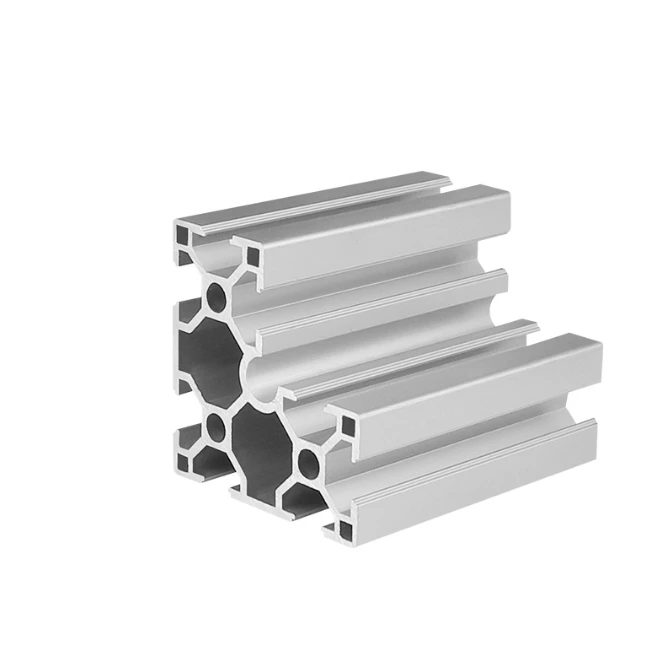
European Standard 6630 Aluminum Extrusion Profile for Architectural Frames and Industrial Structures
European Standard 6630 Aluminum Extrusion Profile
This European standard 6630 aluminum extrusion profile is formed by hot extruding an aluminum billet through a shaped die, producing a continuous cross-section with consistent geometry along the full length. The process suits architectural and industrial framing where repeatable dimensions and a straight, workable profile are needed.
Extruded aluminum is chosen for its favorable strength-to-weight ratio, resistance to atmospheric corrosion, and ease of forming. Because the section is created in a single pass through the die, wall thickness and outer dimensions stay uniform from end to end, which simplifies cutting, drilling, tapping, and assembly in the workshop or on site.
Cross-Section and Dimensional Consistency
Profiles of this type are supplied in a defined cross-section that can be cut to length and machined for a given assembly. Straightness, twist, and dimensional tolerance are controlled during extrusion and cooling so the profile sits flat and aligns cleanly when assembled into larger frames, and the consistent section supports repetitive production runs.
Material and Surface
The profile is made from aluminum alloy and can be supplied in a mill finish or with a selected surface treatment to suit the environment. Treatments commonly applied to extruded profiles include anodizing, powder coating, and polishing, each changing the appearance and the level of surface protection. The suitable finish depends on exposure conditions and the visual requirement of the finished assembly.
Typical Applications
- Architectural framing and structural support sections
- Industrial equipment frames and machine guards
- Workbenches, shelving, and modular assembly systems
- Display stands, partitions, and decorative trim
- General fabrication needing a light, rigid profile
Fabrication and Customization
The profile can be cut, drilled, tapped, and joined with standard aluminum fabrication methods. Being light, large frames can be handled and assembled with less effort than comparable steel structures while still providing stiffness for many structural and semi-structural duties. Cross-section shape, cut length, alloy, temper, and surface finish can be reviewed against project requirements before production.
Summary
This European standard 6630 aluminum extrusion profile is a practical, workable section for architectural and industrial framing. Its uniform cross-section, light weight, and adaptability to common fabrication methods make it a versatile choice for frames, supports, and assembled structures requiring a consistent extruded profile.
Wall Thickness: 2 mm
Our company has two departments-technical & producing department and trade department. Specializing in titanium materials and stainless steel products research and development, production and marketing services. We mainly produce and provide standards based on international standards and China's high-quality titanium and stainless steel products---- titanium sheets, titanium rods, titanium tube, titanium wire, titanium foil, titanium standard parts and other non-standard parts titanium, stainless steel tubes, stainless steel wire and other stainless steel products. Company production factory is located in the suburbs, now has a staff of 200 people, plant area of 100000 square meters;Company sales in the export sector, zhangjiagang channel int'l co.,ltd in urban areas, the existing staff 10 to 20 people.We will continue to innovation, sincere communication with all partners, create the biggest value for customers, welcome to contact us.
A. Our company is an integrated set of industry and trade company.
Q. How to ensure the quality of your products?
A. IS09000, client requirements, product standards, strict inspection to control raw material, production process and final
products.
Q. How do you resolve the problem about your products?
A. Person of aging services: For customer complaints commissioner set up a special complaint handling, complaint issues recorded
the first time and find the relevant person in charge of the feedback and resolve. Details check our "Quality
corrective action report".
Q. What is the MOQ?
A. It depends, different products will be different Sample order is acceptable, and some samples can be free.
Q. How long do you need the delivery time?
1)Supply within 5 -10 days (If products are in our stock list).
2)Customized products need to be calculated according to the quantity.
Q.What 's your payment terms?
A. T/T, L/C at sight , Western Union.
Q.How can we get your price ?
A. We need below information to quote for you:
1. Product Name
2. Standard
3. Material Grade (Chemical Composition)
4. Dimension
5. Quantity
6. The Drawing for Special Parts