Product Overview
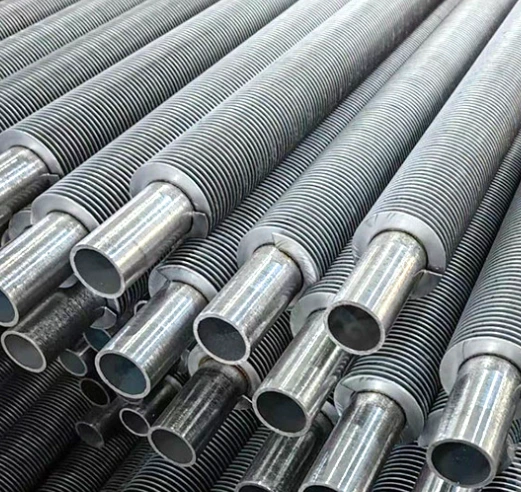
The extruded aluminum fin tube is the finned working section of a heat exchanger coil. A single aluminium tube is extruded with fins rising from the same wall as the tube itself, so fin and tube are one continuous piece of metal rather than two parts joined afterwards. This construction suits duties where air or another gas has to be warmed or cooled across a large surface, and where the coil must stay free of the gaps and contact losses that appear when fin and tube are made separately.
Integral Extruded Fins
Because the fins are formed in the same extrusion as the tube wall, there is no brazed or mechanically wrapped joint between them. Heat passes from the tube wall into the fin without crossing an interface, and the fin does not work loose when the coil expands and contracts through repeated heating and cooling cycles. The one-piece section also holds its shape during coiling, so the fin spacing set at the mill stays even along the bundle.
Heat Transfer Behaviour
Fins multiply the surface area exposed to the air stream, which is why a finned tube transfers far more heat per metre than a plain tube of the same bore. The extruded fin keeps that area working: because the metal path from tube to fin tip is continuous, the fin tip stays close to the tube temperature and the whole fin contributes to the exchange instead of only the part nearest the root.
Typical Applications
- Heat exchanger coils for air heating and air cooling duties.
- Air cooler and condenser bundles in refrigeration and process cooling.
- Steam and hot water coils in air handling and drying equipment.
- Cooling coils in compressors, generators and engine-driven equipment.
Handling and Installation
The tube is handled as a coil component rather than a finished assembly: it is bent, cut to length and stacked into the bundle at the point of coil manufacture. The integral fin tolerates this handling without the fin-to-tube movement a wrapped fin shows, and the tube ends stay clean for the return bends and headers that complete the circuit. Fins should be kept free of crushing in storage, since a flattened fin reduces the surface that does the work.
Matching the Coil
The fin tube is selected against the duty it has to serve, so the details that matter are the tube bore and wall, the fin height and spacing that suit the air side of the coil, and the length of finned section the bundle needs. Describing the medium inside the tube, the air or gas passing outside it and the working temperature range allows a matching fin tube to be confirmed before the order is placed.