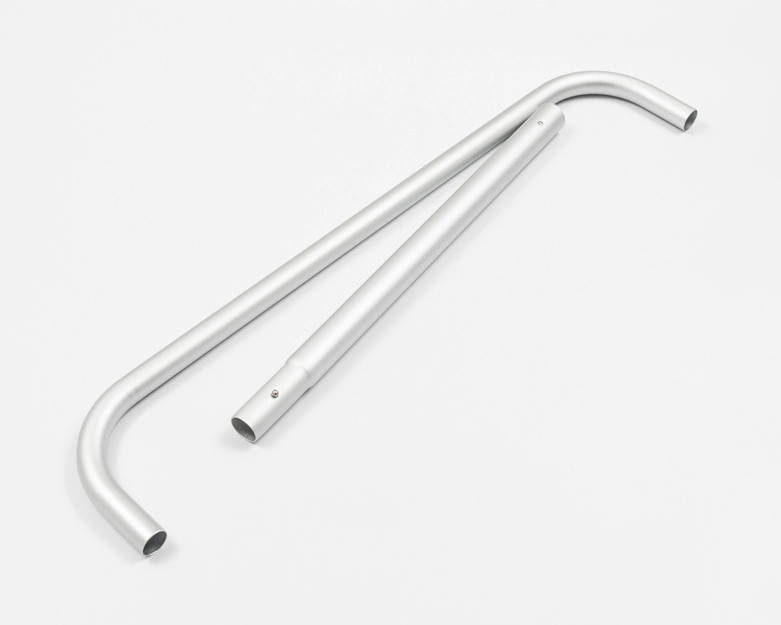
A 90 degree bent aluminium tube is formed into a right angle instead of a gentle sweep, so the two legs meet at a square corner. It is used where a frame, rail or support turns a corner in one piece rather than being joined from two separate tubes, cutting the number of welds, brackets and fixing points in the assembly.
The starting stock is aluminium alloy tube, commonly in grades such as 6063 or 6061 with a temper chosen to suit the bend severity. Softer tempers form more easily on a tight radius, while harder tempers keep a straighter leg and add strength in service. Tube sizes from about 12 mm to 76 mm outside diameter with wall thickness from about 1.2 mm to 5.0 mm cover most right angle frame parts.
Right angle bends are usually produced by rotary draw bending with a mandrel and a wiper die. The mandrel supports the inside of the wall so the tube does not collapse at the corner, and the wiper die controls the material as it is drawn around the bend die. Springback is measured on the first part and allowed for in the tooling.
The bend radius is set by the tooling. A centreline radius of about one and a half to three times the outside diameter is common for frame work, and a larger radius gives a smoother transition with less thinning on the outside of the corner. Leg lengths are measured from the tangent points, so the drawing should state the reference used.
Forming a right angle stretches the outside wall and compresses the inside wall, so the wall becomes thinner on the outer radius and may wrinkle on the inner radius if the tooling is not set correctly. Production parts are checked for wall thickness at the bend, ovality across the section and surface condition on both sides of the corner.
Tubes can be supplied in the mill finish, anodized or with a coloured coating, and the finish is applied after bending so the corner carries the same surface as the straight legs. Where the part is visible in the finished product, bends are handled carefully so the formed surfaces reach the assembly free of marks.
Each lot is inspected against the drawing before dispatch. Checks cover the bend angle, the leg lengths, the radius, the flatness of the section at the corner and the general surface condition. Parts that will be welded or bolted into a frame are checked so the corner sits square when the assembly is put together.
Common uses include handrail corners, guard rail frames, display stand frames, machine guard corners, rack uprights and support brackets. Please share the alloy, tube size, wall thickness, bend radius, leg lengths, bend angle, surface finish and a drawing when asking for a quotation so the tooling and forming route can be confirmed.